
CPI vs. PPI: The Simplest Way to Read Inflation News
CPI reflects the prices consumers actually experience, while PPI tracks prices at the production stage for businesses. Understanding the difference makes inflation news and interest-rate outlooks much easier to read.
- By
- Sungnavi
- Published
- Updated
- 4 min read
- 4 min read
- CPI
- Price Indicators
- Interest Rates
- Inflation
- PPI
In this article
Among the economic terms commonly encountered in the news, the consumer price index (CPI) and producer price index (PPI) are both important indicators of how prices are moving. Both indicators show price trends, but they differ critically in whose prices they measure and at which stage of a transaction.
The CPI represents the shopping-basket prices we actually pay at supermarkets, restaurants, and hospitals, while the PPI represents shipment prices when factories or businesses first bring products to market. Understanding this difference alone makes economic news much easier to read. Comparing the two indicators can reveal at a glance whether the burden of rising prices remains at the business stage or has reached consumers.
CPI reflects the prices consumers experience
CPI stands for the consumer price index, which tracks changes in the prices of goods and services that households purchase for everyday life. Representative categories include food, housing, transportation, healthcare, and dining out. When the news simply reports that prices have risen, it usually refers to the CPI.
Because the CPI directly affects the lives of the general public, it is also one of the most important indicators considered by central banks such as Korea’s central bank and the U.S. Federal Reserve when setting policy rates. When the CPI is high, they may consider raising rates to contain prices or may find it difficult to lower rates that have already risen. Conversely, when the CPI is low or stable, easing price pressures may create room for rate cuts. When examining the CPI, the key is to check the rate of change from the previous year or previous month rather than focusing only on the level of the figure itself.
PPI shows price trends at the production and shipment stage
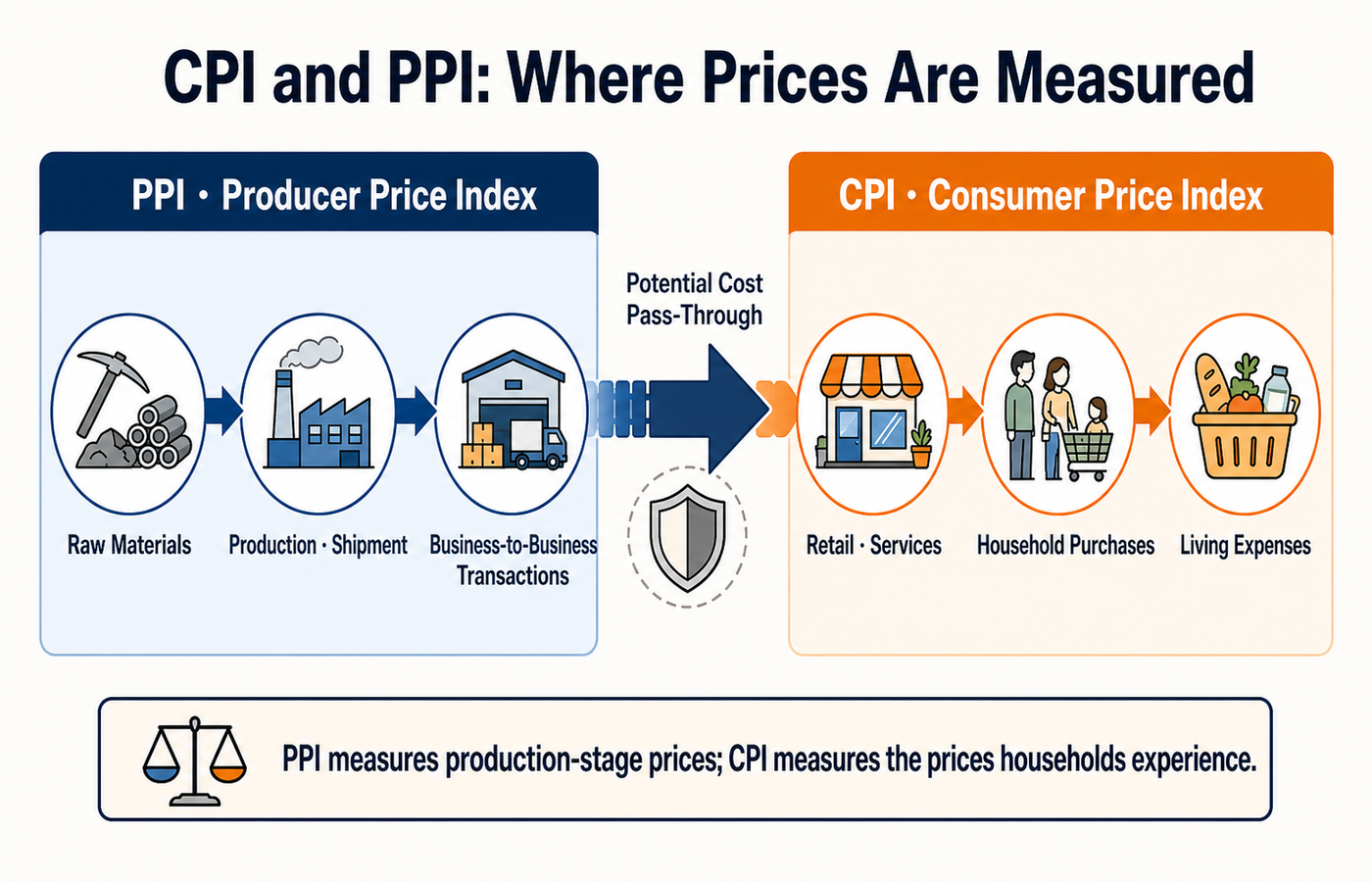
PPI stands for the producer price index, which measures prices when producers ship goods and services to the market. It is easy to associate the PPI only with raw materials or components, but it also includes the wholesale prices of consumer goods shipped from factories to the distribution stage. It comprehensively covers raw materials, capital goods such as factory machinery, and business-to-business services such as transportation, IT, and finance. When oil prices, raw-material prices, or logistics costs rise, the PPI rises first, indicating that businesses face a greater production-cost burden.
When the PPI rises, does the CPI immediately rise as well? Not necessarily. When consumption is strong—that is, when economic conditions are favorable—businesses can more easily pass higher costs on through consumer prices, causing the CPI to rise. When economic conditions are weak and consumption contracts, however, businesses risk losing sales if they raise prices too freely. They may instead absorb the increase themselves, accept the loss, and reduce their margins. In this case, the PPI may rise while the CPI moves very little. The PPI therefore serves as an early warning indicator that can help anticipate whether consumer prices may rise later.
Why examine both indicators together?

Comparing the CPI and PPI provides a broader view of where inflationary pressure is currently concentrated. If the PPI is rising while the CPI remains unchanged, businesses are struggling to bear higher input costs, which may eventually be passed on to consumer prices over time.
Conversely, if the PPI is falling while the CPI remains high, factory shipment prices may have stabilized, but the decline may not yet have reached the distribution stage or retail prices.
Both indicators are also useful in the stock market. Because the PPI measures cost pressures, it provides clues for forecasting the profitability and margins of individual businesses or industries. The CPI helps indicate the likely direction of central-bank interest-rate policy and therefore affects sentiment across the broader stock market. However, it is difficult to determine the direction of an industry’s or individual stock’s price from either indicator alone.
Points beginners often find confusing
The first common misunderstanding among beginners is that a rise in the PPI causes the CPI to rise immediately. There is a clear time lag between the two indicators because businesses often cannot reflect higher costs in their selling prices right away or choose to absorb them themselves.
The second misunderstanding is to assume that prices have fallen simply because the reported figure has become smaller. If the news says that the CPI inflation rate fell from 4% last month to 3% this month, this does not mean the price level itself declined. It means that prices are still rising, but at a slower rate. For the price level itself to fall, the rate of change must be negative (-).
When reading the news, it is therefore useful to check whether the CPI and PPI are moving in the same direction or diverging. It also helps to distinguish whether the rate of change is measured year over year or month over month and to connect it with news about oil prices, exchange rates, and interest rates. Developing these habits will make the broader economic picture easier to see.
Related articles
Why the Economy Should Be Read as a Flow, Not Just as Numbers
Viewing an economic indicator as a single number can easily create a misleading impression. Learn how to read the economy’s underlying flow by examining the direction and speed of quarter-over-quarter and month-over-month changes, the limits of annualized rates, seasonal adjustment, and the possibility of data revisions.
- Economics Basics
- Seasonal Adjustment
- Economic Indicators
- Annualized Rates
- Economic Growth Rates

How PCE and Core PCE Differ: How the Fed Reads Inflation
We examine the measurement scope and calculation methodology of PCE and core PCE, as well as their differences from the consumer price index (CPI). We also explain why the U.S. Federal Reserve targets 2% headline PCE while using core PCE to track underlying inflation trends.
- PCE
- Core PCE
- Federal Reserve
- consumer price index (CPI)
- monetary policy